
Screen Time, Young Adults, and the Battle We’re All Fighting
One of the quotes on the front page of my website says:
“Kids learn more from what we do than from what we tell them.”
I keep that quote there as a constant reminder to myself.
Because parenting is pretty easy when all you have to do is tell your kids what they should be doing.
“Get off your phone.”
“Stop wasting your time.”
“Go outside.”
“Read a book.”
“Go do something productive.”
The problem is that kids have an annoying habit of watching what we actually do.
And when it comes to phones, that’s where things get a little uncomfortable.
Because how we use our phones is no different from anything else we try to teach our kids.
We Finally Gave Them Phones
This year, we finally caved.
Our three oldest kids got phones.
Our son is 18, and our two daughters are 16.
Yes, you read that correctly.
They had never had a phone before.
Not their own, anyway.
For years, the only reason they would have needed one was basically social media and games. We didn’t see much point in giving them a device that would mostly become a portable entertainment machine.
But things change.
They’re getting older. They’re starting to work. They need a way to communicate with their employers. They need to be reachable.
A phone suddenly became a useful tool instead of just an expensive rectangle designed to steal their attention.
Of course, along with the useful stuff came the other stuff.
Social media.
Videos.
Games.
Endless scrolling.
“With great power comes great responsibility.”
I wonder if Spider-Man has a Facebook page.
The Problem Isn’t the Phone
The problem isn’t really the phone.
It’s what the phone does to our brains.
As adults, we already know how difficult it can be to put the thing down.
You pick it up to check one message.
Then you see a notification.
Then you watch a video.
Then another.
Suddenly you’re watching a guy in another country restore a 1973 lawnmower while eating a sandwich, and you’re not even sure how you got there.
And somehow 45 minutes have disappeared.
The scary part is that it doesn’t require any effort.
That’s what makes it so addictive.
If I want to entertain myself without my phone, I might have to get up.
I might have to go outside.
I might have to start a project.
I might have to read.
I might have to go fishing.
I might have to build something.
The phone requires none of that.
Just sit down and scroll.
And after a full day of school or work, when you’re tired, choosing the easy option becomes incredibly tempting.
Discipline is hard when you’re exhausted.
What Happened to the Things They Loved?

This is where we really started noticing a problem.
One of my daughters loves to read.
The other loves animals, especially dogs.
My son loves fishing.
These are things they genuinely enjoy.
But after they got their phones, those things started disappearing.
Not completely.
But enough for us to notice.
Reading a book requires concentration.
Taking care of animals requires getting up and doing something.
Going fishing requires preparation, going outside and actually fishing.
Scrolling requires absolutely nothing.
And that’s the competition we’re putting those activities up against.
A book is competing with thousands of videos.
Fishing is competing with an endless stream of entertainment.
Going outside is competing with a device that can entertain you indefinitely while you sit on the couch.
No wonder it’s difficult.
Einstein supposedly said, “Laziness is a sign of intelligence.”
Humans sure are smart.
So What’s the Answer?
We don’t want to completely ban technology.
That’s not realistic.
They’re young adults.
They’re going to have phones.
They’re going to use social media.
They’re going to need technology for work and eventually for almost every aspect of their adult lives.
Our job isn’t to keep them away from technology forever.
It’s to teach them how to control it.
And that’s a very different thing.
So we’re once again trying to find that sweet spot.
Something fair.
Something reasonable.
Something that gives them freedom while still teaching them discipline.
Our current experiment is pretty simple.
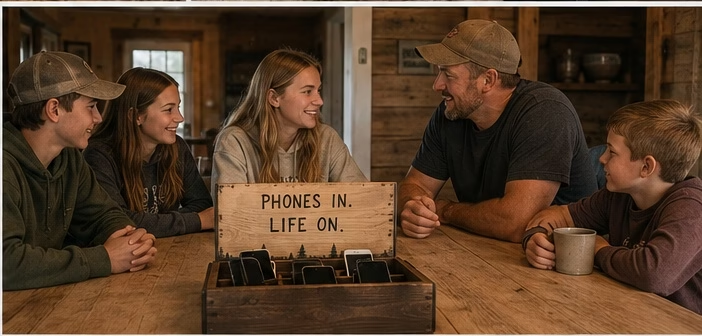
When school and work are done, the phones go in the box.
No screens during the week.
Everyone comes home, and the phones go into a box.
It’s not just the kids.
Well…
We’re working on that part.
“But What If I Want to Listen to Music?”
Of course, the kids immediately started looking for loopholes.
The first argument was:
“But what if we want to listen to music?”
Fair enough.
So we bought Bluetooth headphones and speakers.
Problem solved.
Then came:
“But we don’t like the sound of our alarm clock. With our phones, we could choose whatever music we wanted to wake up to.”
Again, pretty creative.
Our answer?
“If it’s really that important to you what song you wake up to, buy an alarm clock that lets you download whatever song you want.”
Kids will always look for a chink in the armour.
That’s part of being a kid.
And honestly, it’s part of being an adult too.
Then They Hit Us With the Ultimate Argument
And this is where they got us.
They looked at us and said:
“But you and Mum look at your phones before going to bed.”
Damn.
They’ve got a point.
It’s amazing how quickly your parenting philosophy can fall apart when your kids start applying it to you.
I can justify it in my head.
I’m working on my blog.
I’m researching something about the homestead.
I’m looking up something about woodworking.
I’m checking something for the farm.
I’m answering a message.
I’m doing something useful.
Except…
Oh look!
A funny fail video.
And there goes another 20 minutes.
That’s the problem.
We can convince ourselves that we’re using our phones productively while we’re doing exactly the same thing we’re telling our kids not to do.
This Is Where Parenting Gets Hard

This is the part nobody talks about enough.
It’s easy to tell your kids what to do.
It’s much harder to do it yourself.
If I tell my kids that their phones need to be put away but I’m sitting on the couch scrolling through mine, what lesson am I actually teaching?
That the rules apply to them because they’re kids?
That adults have better self-control?
Clearly not.
The kids can see right through that.
And they’re right.
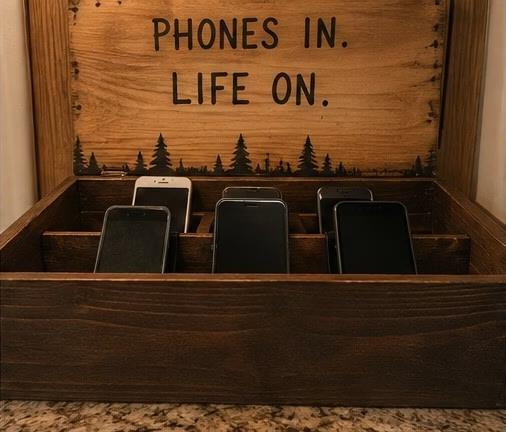
So we built a box.
A simple box where everybody puts their phone at the end of the day.
And that includes me.
That’s important.
Because if we’re going to break a bad habit, we’re going to do it together.
It’s Going to Be Hard
They’ve had unrestricted access to their phones all summer.
Now we’re asking them to put them away every night.
That’s not going to be easy.
Try taking something away from an adult that they’ve been doing every day for months.
Now imagine doing it to a teenager.
We’re going to have some resistance.
There will probably be some arguments.
There will definitely be some creative loopholes.
And I’m sure someone will eventually come up with a perfectly reasonable explanation for why they absolutely, positively need their phone at 8:47 on a Tuesday night.
But that’s okay.
We’re not trying to make them miserable.
We’re trying to teach them something.
Freedom requires discipline.
Having access to something doesn’t mean you need to use it constantly.
Having a phone doesn’t mean you need to answer every notification.
Having access to entertainment doesn’t mean you need to be entertained every waking minute.
And being bored isn’t necessarily a bad thing.
Sometimes boredom is where creativity starts.
Maybe We Need to Get Bored Again
I think we’ve forgotten how to be bored.
And boredom used to be normal.
You’d sit around with nothing to do.
Eventually you’d find something.
You’d pick up a book.
Go outside.
Build something.
Fix something.
Talk to somebody.
Go fishing.
Take the dog for a walk.
Maybe you’d even stare at the ceiling for a while.
And somehow we survived.
More importantly, we learned how to entertain ourselves without someone else providing the entertainment.
That’s a skill worth keeping.
Especially for young adults who are about to enter a world where technology will only become more integrated into their lives.
We’re not going to be able to protect them from every distraction.
We can’t.
Eventually, they’ll be living on their own.
They’ll have their own homes, their own jobs, their own money and their own phones.
Nobody will be standing there telling them to put it in the box.
That’s why we’re trying to teach them now.


And That Means Teaching Ourselves
The hardest part of this whole experiment might not be getting the kids to put their phones away.
It might be getting me to put mine away.
Because I have the same problem.
I can come up with a hundred reasons why what I’m doing on my phone is important.
Sometimes it is.
Sometimes I’m researching something for the homestead.
Sometimes I’m working on this blog.
Sometimes I’m looking something up.
And sometimes I’m just watching a guy fall off a bicycle.
The phone doesn’t care which one I’m doing.
And neither does the algorithm.
It just wants me to keep scrolling.
So maybe the real lesson here isn’t about screen time for kids.
Maybe it’s about screen time for the whole family.
Because our kids don’t need another lecture from us about how phones are addictive.
They need to see us put ours down too.
They need to see us choose a book over a screen.
Choose a conversation over scrolling.
Choose a walk over a video.
Choose to sit around the kitchen table and do absolutely nothing rather than reach for the phone.
That’s the example they will remember.
We’re Still Figuring It Out
I don’t know if our new system is going to be perfect.
It probably won’t be.
Maybe we’ll adjust it.
Maybe weekends will be different.
Maybe certain exceptions will make sense.
Maybe we’ll eventually find that sweet spot where phones are a useful tool without becoming the centre of everyone’s lives.
But we’re going to try.
And we’re going to try as a family.
Because that’s the important part.
If I’m asking my kids to develop better habits, I have to be willing to develop them myself.
The phone box sitting on the counter isn’t really a box for their phones.
It’s a reminder for all of us.
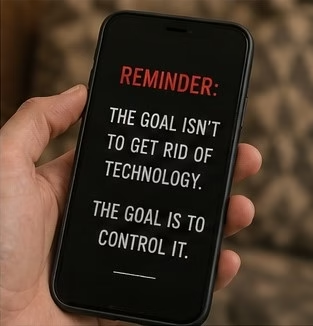
A reminder that we control the technology.
It doesn’t control us.
At least…
That’s the goal.
Now if you’ll excuse me, I have to go put my phone in the box.
Right after I watch this one really funny video.