

The Sound of Silence
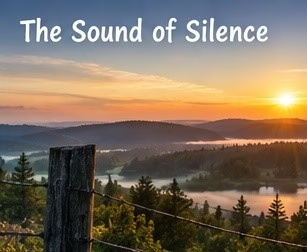
Have you ever really heard the sound of silence?
I don’t mean a quiet room.
I mean silence.
The kind of silence you hear when the electricity suddenly goes out.
It’s so loud it can almost wake you from a deep sleep.
When the power goes out in our house, something strange happens. The refrigerator stops humming. The furnace stops. The fans stop spinning. The lights go out. The little electronic noises we’ve become so accustomed to disappear one by one.
And suddenly, you can hear yourself think.

I remember the first time my wife and I went for a walk after we bought our home in the country. We’d spent most of our lives surrounded by noise. Cars, neighbours, traffic, machinery, televisions, radios—there was always something making a sound.
But that first walk was different.
We walked down the road, away from the house, and eventually we just stopped.
We looked at each other.
There was almost nothing.
No traffic.
No city noise.
No constant hum of civilisation.
Just the wind moving through the trees, birds somewhere in the distance, and our own footsteps.
That sound of silence stopped us in our tracks.
Years later, I was walking my dog around our property one morning when I found myself thinking about it again.
And, of course, because I’m a music guy, my mind eventually wandered toward music.
I bring music with me almost everywhere I go.
In the truck.
Around the house.
While I’m working.
While I’m doing chores.
If there’s an opportunity to turn the music up, chances are pretty good I’ll take it.
But there is one place where I don’t bring it.
My morning walk.
That walk is mine.
No headphones.
No phone playing in the background.
No podcast.
Just me, the dog and the forest.
And that morning, as I walked through the trees, I started wondering something.
Where did music come from?

Nobody knows exactly how the first song was created.
Maybe it started with a hum.
Maybe someone discovered that certain sounds felt good together.
Maybe it started with words.
Or maybe it started with something as simple as a stick being tapped against a rock.
Tap.
Tap.
Tap.
Maybe someone discovered a rhythm.
Maybe another person joined in.
Then another.
Maybe someone started humming.
And eventually, without anyone really knowing what they were creating, music was born.
I started imagining what life must have been like thousands and thousands of years ago.
Picture a group of people sitting around a fire at night.
The sun has disappeared.
The forest surrounding them is completely dark.
They don’t have electric lights.
They don’t have houses with locked doors.
They don’t have phones.
They don’t have motion-activated lights or security cameras.
They have a fire.
And each other.
Every sound coming from the darkness could mean something.
A branch breaking.
Leaves moving.
An animal calling somewhere beyond the light of the fire.
Maybe those first sounds weren’t music at all.
Maybe they were communication.
Maybe they were warnings.
Maybe people made noises to scare predators away.
Maybe someone began humming simply because the sound was comforting.
Then someone else joined in.
And perhaps those sounds slowly became something more.
A rhythm.
A melody.
A song.
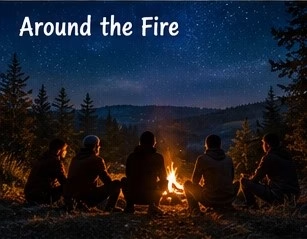
I can imagine that group sitting around the fire, humming together, using their voices to soothe themselves against the dangers surrounding them.
Because there is something incredibly soothing about music.
Think about a mother singing a lullaby to her baby.
The child doesn’t understand the words.
They don’t need to.
It’s the sound.
The rhythm.
The familiar voice.
The repetition.
Music can calm us before we even understand why.
Animals communicate with sounds too.
Some sounds are beautiful. Others aren’t quite as pleasant to our ears.
Birds sing.
Wolves howl.
Whales communicate across enormous distances.
Dogs bark, whine and growl.
But I wouldn’t necessarily call all of that music.
And yet, in our own way, humans have taken sound and turned it into something extraordinary.
Every culture on Earth has music.
And every culture has language.
I’ve always found languages fascinating because they almost sound like music themselves.
French has those rolling R’s that seem to come from somewhere deep in the back of the throat.
Some Asian languages have a quick, almost percussive quality to them, with sounds that seem to bounce around the mouth.
Some South American languages have incredible changes in tone and rhythm that can make ordinary conversation sound almost musical.
And English has its own natural flow and rhythm.
Every language has its own tempo.
Some are fast.
Some are slow.
Some sound sharp.
Others sound soft.
Some seem to rise and fall constantly.
But none of them quite have the structure of a song.
And maybe that’s because language is meant to communicate an idea, while music is capable of communicating something that words sometimes can’t.
That’s what makes music so powerful.
There are very few things that can evoke such a strong emotion almost instantly.
You can hear a song you haven’t heard in twenty years and suddenly you’re sixteen again.
You can hear a certain melody and remember someone you haven’t thought about in years.
A song can make you happy.
It can make you angry.
It can make you cry.
It can make you want to get up and dance.
It can make you want to drive faster.
It can make you want to sit quietly and stare out a window.
I’ve always wished I could control music like they do in movies.
Imagine having your own personal soundtrack.
You walk into a room and suddenly the music starts.
The hero makes his first appearance.
Cue the epic music.
You walk away from an explosion in slow motion.
Cue even more epic music.
Okay, maybe that’s just me.
But think about how important music is in movies.
Take the exact same scene and remove the music.
Suddenly it feels different.
Even a sad scene can fall completely flat without the right music.
The right song can turn a good moment into an unforgettable one.
Music doesn’t just accompany our lives.
Sometimes it becomes part of the memory itself.
And we’ve taken this strange human ability to create organised sound and turned it into one of the biggest industries on Earth.
We idolise musicians.
We study music.
We teach it in universities.
We build entire careers around understanding it.

There are more styles and genres of music than I could ever possibly name.
Rock.
Country.
Classical.
Jazz.
Blues.
Rap.
Reggae.
Electronic.
Folk.
Metal.
Pop.
And thousands upon thousands of variations in between.
It’s almost as if there are as many kinds of music as there are colours.
Some music makes one person feel extreme joy while another person can’t stand listening to it for thirty seconds.
And music isn’t just entertainment.
It’s been part of human spirituality for thousands of years.
We sing in celebration.
We sing when we’re grieving.
We sing during ceremonies.
We sing at weddings.
We sing at funerals.
We sing to our children.
And we sing in worship.
In the Bible, David was known not only as a warrior and king but as a musician and psalmist. His music was deeply connected to his relationship with God.
It makes me wonder.
Were we created with music already built into us?
Is there something in our brains that naturally searches for rhythm and melody?
If you took a group of people and put them on a deserted island—people who had never heard a song, never seen an instrument, never experienced recorded music—and left them there long enough…
How long would it take them to start singing?
Would someone eventually begin humming?
Would another person find a rhythm by tapping a stick against a log?
Would children naturally start making up songs?
I don’t know.
But I’d love to find out.
Because maybe music isn’t something we invented.
Maybe it’s something we discovered.
And yet, as much as I love music, there is another sound that I’ve come to appreciate just as much.
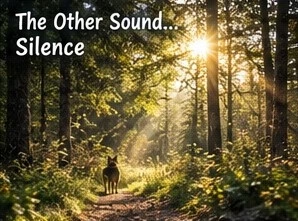
Silence.
Real silence.
Living in the country has taught me that silence isn’t actually silent.
When I walk through our property in the morning, there is always something happening.
The wind moves through the trees.
Leaves rustle.
Birds call to each other.
Branches creak.
The dog walks through the grass beside me.
Sometimes I hear an animal moving somewhere I can’t see.
And then there are those moments when everything seems to stop.
Those are my favourite moments.
Sometimes I’ll sit beside a fire and turn off everything else.
No music.
No television.
No phone.
Just the crackling of the wood.
Crack.
Pop.
Crackle.
And somehow, that’s music too.
Maybe that’s the irony.
We spend so much of our lives trying to fill every moment with sound that we forget how beautiful the absence of sound can be.
We wake up and immediately reach for our phones.
We drive with the radio on.
We work with music playing.
We watch television while scrolling through our phones.
We put headphones on when we go for a walk.
Even when we’re alone, we’re rarely actually alone with our thoughts.
We’re constantly filling the silence.
Maybe that’s why meditation has become so popular.
Maybe people are simply craving something we’ve forgotten how to experience.
Stillness.
Quiet.
Silence.
I’m not saying we should all throw our phones into the woods and live without electricity.
Believe me, I enjoy my electricity.
And anyone who knows me knows I enjoy having music blasting through the house.
But maybe we need a little balance.
Maybe every once in a while we should turn it all off.
Go outside.
Sit beside a fire.
Take a walk through the woods.
Leave the headphones at home.
Listen.
Really listen.

Because when you finally stop trying to fill the silence, you realize something.
The silence isn’t empty.
It’s full of things we were simply too busy to hear.
Maybe that’s what my morning walks have become for me.
A chance to step away from all the noise we’ve created.
A chance to hear the forest.
A chance to hear my own thoughts.
And maybe, every once in a while, a chance to appreciate the strange and beautiful thing we’ve spent thousands of years creating…
music.
But before we turn it back on, maybe we should take a moment to appreciate the sound that came before it.
The sound of silence.